


Unregulated Operators Capture 72% of EU Online Gambling Revenue.

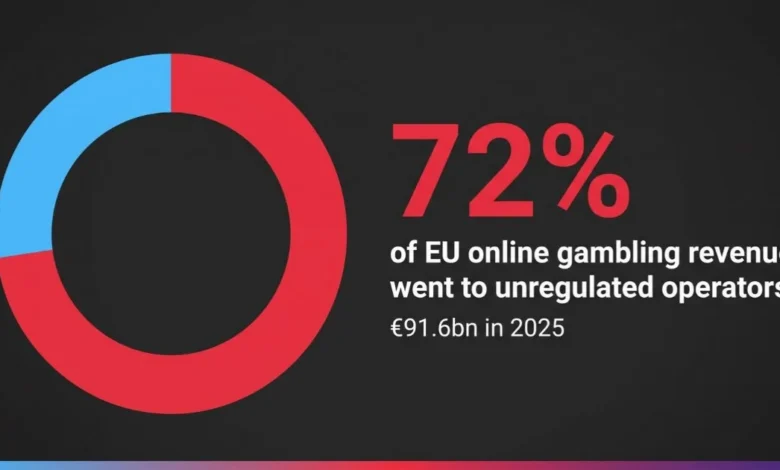
A report prepared for the Campaign for Fairer Gambling (CFG) has highlighted the scale of unregulated online gambling in the European Union, estimating that unlicensed operators accounted for 72% of total online gambling gross gaming revenue (GGR) in 2025.
The findings raise important questions about the effectiveness of existing regulatory frameworks and the ability of licensed operators to compete with businesses operating outside established national licensing systems.
According to the study, Online Gambling 2024–2025: EU 27 Europe, produced by Gaming Compliance International (GCI), unregulated operators generated an estimated €91.6 billion in online GGR across the EU’s 27 member states last year. Licensed operators accounted for €36.5 billion, representing approximately 28% of the €128 billion market.
The report also found that 91% of gambling-related content encountered by highly engaged consumers promoted unregulated operators, pointing to the potential influence of digital marketing and online content distribution on consumer exposure to unlicensed gambling platforms.


Together, these figures highlight a growing challenge for regulators and licensed businesses: maintaining effective consumer protection while ensuring that regulated gambling markets remain commercially competitive.
The Regulatory Challenge: Compliance Costs and Market Competition
Licensed gambling operators across Europe face an increasingly demanding compliance environment, with requirements covering player verification, anti-money laundering (AML), responsible gambling, advertising and consumer protection. In some jurisdictions, additional tax obligations and licensing costs are adding to the pressure.
Meanwhile, unregulated operators may be able to offer products and customer experiences without bearing the same regulatory costs or meeting equivalent compliance standards.
This creates a competitive imbalance that could undermine the attractiveness of licensed platforms, particularly where consumers perceive unregulated services as offering fewer restrictions or a more straightforward registration and betting experience.
The issue is not simply whether regulatory requirements are necessary. Strong safeguards remain essential to protecting consumers and maintaining the integrity of gambling markets. Rather, the findings raise the question of whether current regulatory approaches are achieving their intended objectives if a substantial share of online gambling activity continues to take place outside licensed systems.
For policymakers, the challenge is to enforce existing rules effectively while assessing whether the design of regulated markets provides consumers with a compelling and sufficiently accessible alternative to unlicensed platforms.
Beyond Lost Tax Revenue: Consumer Protection at Stake
The financial implications are significant. GCI estimates that unregulated online gambling generated €91.6 billion in GGR in 2025 and that the associated potential tax revenue shortfall could reach €22 billion, based on an assumed average GGR tax rate of 24% across the EU.
However, the implications extend beyond public finances.
Licensed operators are generally subject to formal obligations relating to identity verification, anti-money laundering controls, responsible gambling interventions and dispute resolution. Consumers using unlicensed platforms may not receive equivalent protections, although the precise risks depend on the operator and the jurisdiction involved.
The reported finding that 91% of gambling-related content viewed by highly engaged consumers promoted unregulated operators adds another dimension to the debate. It suggests that regulators and licensed businesses may need to pay closer attention to how gambling products are promoted and discovered online, including through affiliates, influencers, search engines and social media.
Nevertheless, exposure to unregulated gambling content does not necessarily mean that 91% of consumers gamble with unlicensed operators. The distinction is important when interpreting the study’s findings.
Can Stricter Regulation Produce Unintended Consequences?
One of the central questions facing European gambling policymakers is how to balance consumer protection with the competitiveness of licensed markets.
Tighter rules can improve safeguards, but their effectiveness also depends on enforcement, consumer behaviour and the availability of attractive legal alternatives. If compliance requirements, taxation or product restrictions create substantial differences between licensed and unlicensed offerings, some consumers may seek alternatives outside the regulated system.
Read Also: Dario Jurčić takes Digitain CCO role to drive Europe and Africa growth
This does not mean that stronger regulation inevitably drives players towards unlicensed operators. Instead, it highlights the need for evidence-based policymaking that considers the combined effects of taxation, product rules, advertising restrictions, verification procedures and enforcement against illegal operators.
For licensed businesses, understanding why consumers choose unregulated platforms is becoming an increasingly important commercial question. Pricing, product availability, user experience, payment options and trust may all influence consumer decisions, alongside the presence or absence of regulatory safeguards.
What the Findings Mean for Europe’s iGaming Industry
The GCI report presents a significant challenge for the European online gambling sector. If its estimates are accurate, the unregulated market is not a marginal part of the industry but a substantial competitor operating across multiple national jurisdictions.
For senior executives at major operators, investors and suppliers, the figures raise questions about market share, customer acquisition costs, sustainable growth and the long-term economics of regulated gambling.
For regulators, the findings reinforce the importance of combining proportionate regulation with effective enforcement against unlicensed operators. Measures targeting illegal advertising, affiliate activity, payment processing and consumer access may be relevant, provided they are implemented consistently with applicable law.
The industry may therefore need to move beyond treating compliance as a standalone legal obligation and consider how responsible gambling, consumer trust and a competitive product offering can work together.
Ultimately, the objective should not be to weaken consumer protections to compete with unregulated operators. It should be to build regulated markets that protect consumers, enforce the rules effectively and offer a credible alternative to unlicensed gambling.
The central question is whether Europe’s regulatory systems can close the gap between their intended protections and the realities of the online gambling market. The figures reported for 2025 suggest that addressing that gap will remain a major priority for the industry in the years ahead.
Source: Gaming Compliance International, Online Gambling 2024–2025: EU 27 Europe, prepared for the Campaign for Fairer Gambling. Market figures and estimates are attributed to the report and should be interpreted in light of its methodology.